Mount Everest
The ClimbMount Everest is both the setting of the book’s central climbing story and an active constraint on every plan made there. In 1996, commercial expeditions converged on its Nepalese side during the spring climbing season, but the mountain’s unstable routes, extreme altitude, and sudden weather made the gap between a summit bid and survival perilously narrow. The storm that trapped climbers above 8,000 meters on May 10 gives that danger its starkest form; the season’s route work and expedition arrangements show how much human coordination the ascent required before that crisis began.
Setting and Seasonal Ascent
The book introduces the mountain through its spring season, the interval between winter’s retreat and the summer monsoons when Everest expeditions had historically enjoyed their greatest success. In March 1996, the comet Hyakutake appeared over the Himalaya, a striking presence that Sherpas discussed as an ominous sign. The season’s promise of a favorable climbing window existed alongside a long record of fatal risk: by 1996, more than 140 climbers had died on Everest since the first summit attempt in 1921, and almost 40 percent of those deaths had been Sherpas.
The mountain’s danger is concentrated in the Death Zone above 8,000 meters. There, cold and oxygen deprivation make prolonged exposure lethal. The book’s prologue moves directly from that physical fact to the storm of May 10: twenty-three climbers who had ascended from Nepal could not reach the safety of their highest camp as hurricane-force winds and near-whiteout conditions persisted for more than ten hours. Oxygen gauges fell to zero, hypoxia undermined clear thought, and frostbite made the loss of fingers—and the prospect of amputation—immediate concerns. Everest is not merely a distant summit in this account; its altitude and weather govern what bodies can endure and what decisions remain possible.
Routes, Camps, and Expedition Preparation
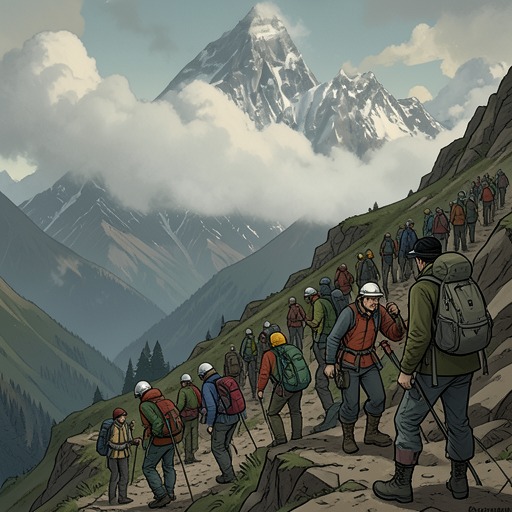
The commercial expeditions relied on a chain of camps and fixed lines to make the route passable. Mountain Madness’s acclimatization plan called for four excursions, beginning with a climb to 6,100 meters, the site of Camp I. On the first outing, clients were to return to base the same day rather than spend the night high on the mountain. They carried only personal gear so as to conserve strength, while climbing Sherpas under Lopsang Jangbu Sherpa carried rope and supplies. The staged plan sought to let climbers adapt progressively and gave the guides opportunities to rest the team and assess its condition.
Route preparation also required cooperation among competing expeditions. When Camp III had not yet been established and Mountain Madness’s Sherpas were exhausted, an agreement among Scott Fischer, Rob Hall, Todd Burleson, Ian Woodall, and Makalu Gau called for joint work fixing ropes between Camps III and IV on April 26. Mountain Madness planned to send Sherpas rather than guides, but that schedule conflicted with establishing Camp III and giving the workers a necessary rest. Anatoli Boukreev was sent in their place. Contributing mattered not only for safety: May 10 was emerging as a possible summit date, and the team did not want to lose its place among the first expeditions able to make a bid.
The dependence on fixed ropes became especially consequential higher on the route. Climbers from the Fischer and Hall teams expected Ang Dorje Sherpa and Lopsang to leave Camp IV ahead of them and prepare the lines so the clients would not have to wait. Instead, no Sherpas had departed early to fix them. Lopsang later said a member of a Montenegrin expedition had told him the ropes were already fixed; Jon Krakauer questioned that account, noting that Lopsang and Ang Dorje nevertheless carried three hundred feet of rope. The discrepancy left the clients’ expectation, the route’s actual preparation, and the guides’ understanding of the situation at odds.
Labor and Commercial Organization
Everest’s expedition economy depended on Sherpa labor across a range of jobs and levels of risk. Sherpas worked as porters, cooks, and yak drivers, as well as high-altitude support personnel who helped establish camps and carry loads. The book describes seasonal wages ranging from $2.50 to $50 a day for this work, while foreign commercial teams brought paying clients to the mountain. By 1996, more than four hundred people would eventually arrive at base camp, a dramatic expansion from the early 1980s, when the spring gathering could have fitted into a single Paris metro car.
The book also places route access and its proceeds within an unequal system. In a later expedition account, the narrator describes seventeen teams at base camp and disputes over which Sherpas would fix the Icefall, since the organizers of that work collected payment from expeditions using the route. A short-lived effort by the Pangboche Sherpa Cooperative to secure the contract did not prevail; Henry Todd and Mal Duff obtained it, and Duff’s Sherpas hurriedly fixed the route. The account criticizes a system in which expedition leaders could benefit from access fees while relying on work by underpaid Sherpas.
That criticism is paired with a proposed alternative: a team of climbing Sherpas could fix the whole route to the summit in advance, with expeditions paying them as contractors and Nepalis eventually controlling access to the mountain. The proposal imagines a redistribution of authority as well as wages. At the same time, the narrator cautions against treating weak expedition staffing as a simple matter of individual blame, observing that it takes years of repeated ascents and consistent financial support to develop a Sherpa team capable of working together with equal strength and skill.
The Summit Route and the Storm
The summit route brought climbers from several expeditions together at the Balcony, a cramped natural resting place where they changed oxygen canisters, drank, and tried to recover. At that altitude, one climber recalled the passage from barely being able to think to being unable to think at all. The planned, advance fixing of ropes was meant to keep the ascending groups moving, but the failure to prepare them as expected made delay a real hazard in a zone where time, oxygen, and physical capacity were all limited.
The ascent plans also depended on different and incompletely communicated expectations about when to turn back. Scott Fischer did not set a definite summit-day cutoff for his clients. His strategy was to have Lopsang and the guides lead in rotation while Fischer brought up the rear and turned around stragglers; if problems arose, he was expected to communicate by radio with Lopsang near the front. Neither Boukreev nor Neal Beidleman had been issued a radio. A published account of Fischer’s personal Two O’Clock Rule described his own guideline, but it did not amount to a clearly stated turnaround time for his clients. Hall’s clients, too, understood different deadlines—one o’clock, two o’clock, or a decision to be made on the mountain.
On May 10, the weather turned the route into a fight for survival. The storm left climbers with visibility sometimes limited to an arm’s length; ropes could offer guidance, but oxygen supplies ran down and hypoxia disrupted rational judgment. The book’s opening account emphasizes the bodily bargain the conditions imposed: in the darkness and roaring wind, climbers confronted the possibility of losing fingers in exchange for life. The crisis makes visible the difference between a route that exists on a plan and one that can actually lead exhausted people safely back to camp.
Narrative Significance
Everest’s physical hazards and its commercial infrastructure are inseparable in the book’s account. Summit ambitions depended on acclimatization, oxygen, fixed lines, communication, and the work of Sherpas, while the crowded season and competition for a favorable place on the route placed pressure on those arrangements. When expectations about ropes, radios, staffing, or turnaround decisions failed to align, the mountain offered little margin for correction.
The narrative therefore treats the mountain as more than a backdrop to individual choices. Its altitude and weather impose hard limits, while its route system draws together clients, guides, expedition leaders, and workers whose responsibilities and resources are not equal. The May storm is the most extreme expression of that structure: plans and commercial ambitions remain human decisions, but their consequences unfold in an environment where cold, oxygen loss, and darkness can swiftly overtake them.